

Uncategorized
Most Commonly Discussed Benefits of Peptide Supplements in Modern Research
Jul
Introduction: Why Peptide Supplements Are Receiving Global Attention
Peptide research has become one of the fastest-growing areas in biotechnology and modern scientific investigation. In 2026, peptides continue to attract strong interest from researchers, laboratories, and biotechnology companies due to their highly targeted biological interactions and expanding research applications.
As the market grows, peptide supplements are increasingly discussed across scientific communities, online research forums, and biotechnology publications. Researchers are exploring how peptides interact with biological systems involved in cellular signaling, tissue response, structural protein activity, and metabolic processes.
The growing popularity of peptide supplements is largely connected to their versatility and precision in laboratory studies. While peptides are intended strictly for research purposes in scientific environments, many of the discussions surrounding them focus on their potential biological roles and the pathways they may influence.
This article explores the most commonly discussed benefits associated with peptide supplements in scientific research, the reasons behind their rising popularity, and the trends shaping peptide science in 2026.
Understanding Peptides in Scientific Research
What Are Peptides?
Peptides are short chains of amino acids linked together in specific sequences. They naturally occur in biological systems and are involved in many cellular communication processes.
In laboratory research, peptides are studied because they can interact with highly specific biological targets. This makes them useful tools for investigating complex biological mechanisms
Why Researchers Study Peptides
Researchers use peptides to study:
- Cellular signaling pathways
- Structural protein interactions
- Tissue response mechanisms
- Molecular communication systems
- Biological regulation processes
Their precise activity makes peptides valuable for advanced scientific investigations.
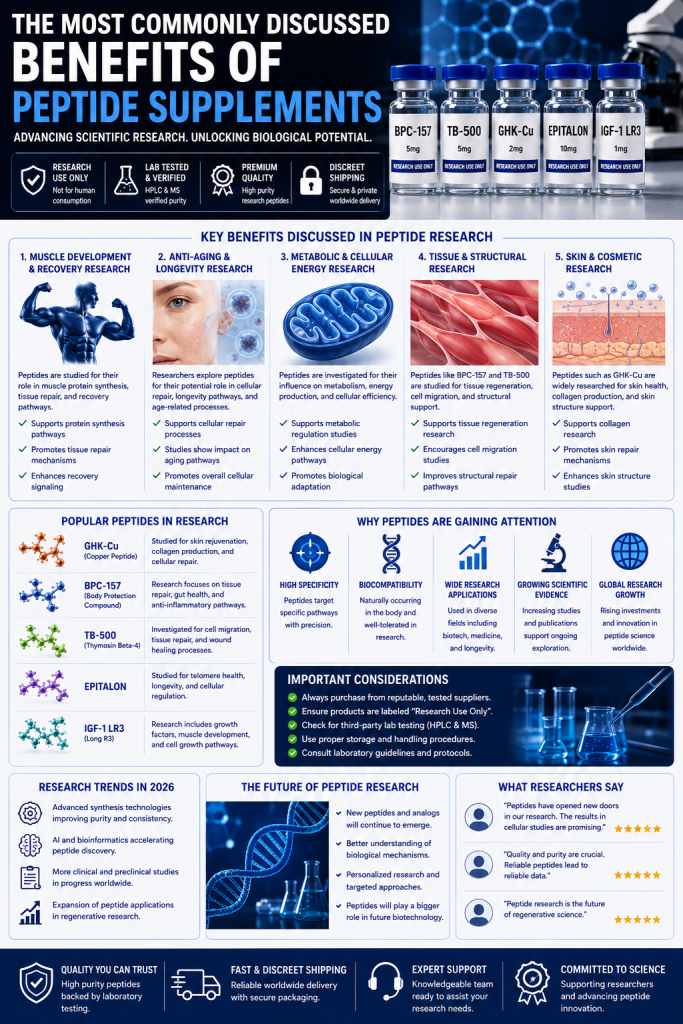
Most Commonly Discussed Benefits of Peptide Supplements
Research Into Muscle Development and Recovery
One of the most frequently discussed topics in peptide research involves muscle-related biological processes. Certain peptides are studied for their interaction with pathways associated with tissue repair, protein synthesis, and cellular recovery mechanisms.
Researchers are interested in understanding:
- Cellular response to stress
- Tissue regeneration pathways
- Biological adaptation processes
This area remains one of the largest sectors in peptide research.
Interest in Anti-Aging and Longevity Research
Anti-aging research is another major reason peptide supplements receive attention. Scientists are exploring how peptides interact with cellular processes associated with aging and structural maintenance.
Common research topics include:
- Cellular repair mechanisms
- Structural protein studies
- Biological signaling related to aging
- Molecular maintenance pathways
Peptides such as GHK-Cu and Epitalon are frequently mentioned in scientific discussions related to these studies.
Metabolic and Cellular Energy Research
Peptides are also being studied for their involvement in metabolic signaling and cellular energy systems.
Researchers investigate how peptides may interact with:
- Energy regulation pathways
- Cellular communication systems
- Biological adaptation responses
This field continues to grow alongside advances in biotechnology and molecular science.
Tissue and Structural Research
Another commonly discussed area is tissue-related research. Certain peptides are studied for their role in biological repair and structural organization processes.
Research interest includes:
- Tissue response mechanisms
- Structural protein interactions
- Cellular organization studies
Peptides such as BPC-157 and TB-500 are often discussed in this context.
Skin and Cosmetic Research Applications
Peptides are increasingly used in laboratory studies involving skin biology and cosmetic science.
Researchers study peptides for their interaction with:
- Collagen-related pathways
- Skin structure analysis
- Cellular communication in skin tissues
Copper peptides such as GHK-Cu are especially popular in these research areas.
Why Peptide Supplements Are Growing in Popularity
Precision and Specificity
One major advantage of peptides is their ability to interact with highly specific biological targets. This allows researchers to study complex systems with greater accuracy.
Compatibility With Modern Biotechnology
Peptides integrate well with advanced laboratory technologies, including:
- Artificial intelligence research systems
- Molecular analysis tools
- Biotechnology platforms
- Automated testing systems
This compatibility supports continued growth in peptide research.
Expanding Scientific Literature
The amount of peptide-related scientific literature has increased significantly in recent years. More universities, laboratories, and biotechnology companies are investing in peptide studies.
This growing body of research helps drive awareness and interest across the scientific community.
Popular Peptides Frequently Discussed in Research
GHK-Cu
Commonly studied in:
- Skin biology research
- Structural protein analysis
- Cellular repair studies
BPC-157
Frequently researched for:
- Tissue response studies
- Cellular recovery mechanisms
- Structural organization research
TB-500
Studied in connection with:
- Cellular migration pathways
- Tissue structure research
- Biological repair processes
Epitalon
Often discussed in:
- Longevity research
- Cellular timing studies
- Biological regulation investigations
IGF-1
Researched for:
- Growth-related pathways
- Protein synthesis studies
- Cellular signaling research
Challenges and Considerations in Peptide Research
Need for Standardized Protocols
As peptide research expands, laboratories are working toward improved standardization to ensure consistent and reproducible results.
Importance of Product Quality
High-purity peptides are essential for accurate scientific studies. Researchers prioritize suppliers that provide transparent laboratory testing and analytical verification.
Responsible Research Practices
Peptides discussed in scientific literature are intended strictly for laboratory research environments. Responsible handling and ethical compliance remain essential.
Technology Driving the Future of Peptide Science
Artificial Intelligence and Peptide Modeling
AI tools are increasingly used to predict peptide interactions and optimize research designs.
This technology helps researchers:
- Analyze complex data faster
- Improve experimental efficiency
- Reduce variability in studies
Improved Synthesis Technologies
Modern peptide synthesis methods allow for:
- Higher purity levels
- Better sequence accuracy
- Greater consistency between batches
These improvements support more reliable scientific outcomes.
The Future of Peptide Supplement Research
Continued Growth in Biotechnology
The biotechnology sector is expected to continue investing heavily in peptide-related studies due to their broad research potential.
Expansion of Global Research Markets
Peptide research is expanding worldwide, with growing interest in the United States, Europe, and Asia.
This global growth is increasing collaboration and accelerating innovation.
Increased Focus on Scientific Transparency
Researchers increasingly demand transparency from suppliers regarding:
- Product testing
- Manufacturing standards
- Analytical verification
- Quality control systems
Companies that prioritize transparency are likely to gain stronger reputations in the industry.
Frequently Asked Questions (FAQ)
What are peptide supplements commonly studied for?
Researchers study peptides for muscle biology, tissue response, cellular signaling, anti-aging science, and metabolic processes.
Why are peptides becoming more popular in research?
Their precision, versatility, and compatibility with modern biotechnology make them valuable tools for scientific studies.
Which peptides are most commonly discussed?
Popular research peptides include GHK-Cu, BPC-157, TB-500, Epitalon, and IGF-1.
Why is peptide purity important?
High-purity peptides help ensure accurate and reproducible laboratory results.
What is the future of peptide research?
Peptide research is expected to grow rapidly due to advances in biotechnology, AI systems, and molecular science.
